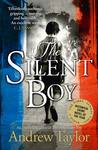
Shadow of the Terrors. The Silent Boy, by Andrew Taylor.

The Silent BoyThe Silent Boy by Andrew Taylor

My rating: 3 of 5 stars

After witnessing the murder of his mother Charles is struck dumb (or rather takes dumb) after the assailant tells him to “Say nothing. Not ever.” He is quickly whisked away to England by the Count de Quillion, one of the men potentially his father, to escape the Revolution, only for the spectre of his mother’s murder to follow him to the quiet countryside of Charnwood House. Savill, Charles’ mother’s estranged husband, is sent to collect him only for the boy to go missing, what first seemed like a runaway turns out to be an abduction. But is this a fight for paternity or is someone out to ensure the Silent Boy remains silent.

Overall the book is enjoyable but I have to admit I found myself a little disappointed – particularly with the historical setting. The blurb, and Goodreads’ own description, sells the book hard as being twisted up in the terrors of the French Revolution, however, the book only spends the first few chapters here before Charles is moved to England. This would be alright if it ever felt like the Revolution played a part in the story but at best it is a superficial contextual sideline. Even London seems a bit drab for the period. Perhaps it is my own historical nerdiness but London at this time would have been the Georgian equivalent of the Cold War, with everyone wary of French spies, or of the insurrectionary feeling spreading to the English working-class. Instead London, or England, we are given occupies the same vague, historically anaemic world, with grimy streets and travelling everywhere by carriage, which most contemporary books set between 1700-1900 use, and require the reader to remind themselves that it’s not Victorian-London-by-way-of-Sherlock-Holmes.

At times it could also be a little slow and doesn’t really pick up speed until halfway through. Yes, this gives the writer two hundred pages to explore characters but in a really good crime novel this is done simultaneously as advancing the plot. Some of the descriptions are wonderful and Taylor is at his best when describing all things visceral – the smell of a pile of compost, the feel of blood on skin – which at least captured the atmosphere, if not the period as above, but there is a sense of not much having happened when the book ends abruptly (in manner I think suggests Taylor is considering a sequel, hopefully, if at all, concerning Charles’ time in France prior).

If you like historical fiction (and aren’t too picky unlike me apparently) and are a fan of Peter James then it’s worth trying out this book, but don’t feel too guilty if you don’t feel the need to rush out to get it.


The Silent Boy
by Andrew Taylor, Hardback £16.99, Paperback £7.99, also available in audio and ebook formats.

Disclaimer: I won this book in a Goodreads/Firstreads giveaway in exchange for an honest review.

View all my reviews

Lust for Life, by Irving Stone.

Lust for LifeLust for Life by Irving Stone
My rating: 3 of 5 stars

Lust for Life is a fictional biography of the post-Impressionist painter Vincent van Gogh. Written as a historical novel Stone presents readers with a good and general overview of Vincent’s life that does not restrict itself to the later years and Vincent’s famous reputation of an ear mangling madman. The book was written using Vincent’s own letters for reference and any one who has read them will recognise certain passages or letters turned to dialogue as they read. However, the book merely skims the surface of who Vincent was and doesn’t really ‘pick up’ until Vincent reaches Paris half way through the book. This I found curious since we know relatively little about Vincent’s stay in Paris – during the period he lived with his brother, Theo, causing there not to be copious letters to document the time. As a result Vincent’s time in Arles (his most creative period) and final battles with his mental health are crammed into the last one-hundred pages. The book is also frustratingly simplistic at times, almost forgetting that it’s fictional and has a licence to emote, leaving the reader a cautious and slightly anaemic description of life that was as explicit and as vivid as the colours Vincent painted with.

As a piece of historical fiction I do accept that certain liberties were taken with Vincent’s life – an easy example is early in the book where a letter conversation has been retold as Theo visiting Vincent – but it felt like some of the historical accuracy was thrown under the figurative bus either because Stone was pandering to period typical taboos and ignorances concerning mental health and sexually transmitted diseases, or from Stone’s own (or I suppose the public’s) hero worship of Vincent. The mental health especially; having read Vincent’s Letters it is quite apparent that Vincent’s mania – whether epileptic or bipolar in origin – is present from the start and worsens as he ages, and over indulges in Absinthe. However, Stone treats it as though it was something that suddenly set on Vincent as soon as he reached Arles, with only vague allusions to obsessive tendencies played off as eccentricities before hand. The book does treat the Paris period of Vincent’s life well and it is the most enjoyable part of the book but by ignoring – or intentionally erasing – Vincent’s fitful changes in mood a key part of WHO Vincent was is lost. I do concede that this could be the fault of the 1930s and Stone not having the same access to information about Depression and mental health disorders in general. However, Stone also erases the fractious relationship between Vincent and his father, Theo’s hand in separating Vincent and Sien, and completely fails to mention the time Vincent spent in a hospital in the Hague most likely being treated for syphilis – the condition is hinted at very, very late in the book but never said out right. Whether it was Stone’s own hero worship or not wishing to besmirch the name of a well loved painter by missing Vincent’s flaws, or even trying to counteract the known reputation of Vincent as a lunatic, I felt that the book did not give a true, whole depiction of the painter as a man.

Another fault, at least from my point of view, was Stone’s depiction of the women in the book. Yes, 1930s I should know better than to expect much but for every relationship it is the woman at odds with Vincent or at fault. Having read the letters I know Sien was no angel but neither was Theo, yet when it comes to the relationship Stone writes it as entirely her fault that the relationship breaks down while Theo is completely absolved. Something similar happens later once Vincent has returned to his parents’ home; while living in Nuenen Vincent is involved with Margot Begemann, her sisters are vindicated in the destruction of the relationship (quite rightly since they were absolutely horrid) but the violent arguments Vincent had with his father are entirely missing. While I accept that such a work has to be more interested in the personal life of the central figure for the sake of drama, the constant use of women as Vincent’s antagonist just seemed cheap. Surely the antagonist of Vincent’s life, if he had one, were the gallery owners and art dealers that refused to show his work? Instead they are treated as necessary challenges for Vincent to over come, even his mental illness is given a similar treatment, while the women are consistently the only destructive influences in his life – a very odd conclusion for Stone to reach when the obvious destructive influence was the toxic quantities of absinthe Vincent was drinking!
This falls back onto my previous comment about hero worship, in making the women ‘bad’ the criticism could be shifted off of Vincent and he continues to fit the ‘struggling artist’ character mould rather than a genuine depiction of the flawed and tormented, albeit wonderful, man that he was.

Overall it is enjoyable and should be read for what it is – a fictional account of a man who the writers wishes he could have met. I think, if you are interested in Vincent van Gogh, it is a book you should read before reading Van Gogh: The Life or any edition of The Letters of Vincent van Gogh, as knowing more about the man than what the book gives only leads to exasperation when you notice something missing.

Note: Even though this edition was published in 1990 the text is littered with phrases in French from Millet (and for the sake of affectation) with no translation footnotes. I read the book with google translate open!

View all my reviews