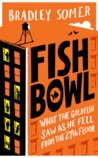
One building, one bowl, several stories. Fishbowl, Bradley Somer.

FishbowlFishbowl by Bradley Somer

My rating: 5 of 5 stars

Fishbowl covers thirty minutes in the lives of the residents of the Seville on Roxy apartment building, all leading their lives without interaction or knowledge of one another until chance and a broken lift forces it on them. Meanwhile outside, spectator to it all, Ian the goldfish is plummeting towards the pavement from the 27th floor.

I really enjoyed this book, it’s humorous and introspective. There is something familiar in all the characters situations – fear of failure, loneliness, the desire to see more of the world than your fishbowl and neon pink plastic castle – even if the particulars are beyond your own experience. Like Petunia, many of us will have never been pregnant or given birth but all of us will have been in an emergency where we reached out and depended on the kindness of strangers.

I found the writing style a little similar to Douglas Adams (minus the science fiction.. obviously) and the stories of each apartment are wonderfully woven together, sometimes with multiple perspectives on a single scene – yes there is repetition but it does so without being tedious.

If you’ve ever sat people watching or been stuck in a queue of traffic and thought “all these people with their separate lives, I wonder where they’re going”, this book entirely captures that feeling.
Go read it.
It’s worth it just for the flip cartoon of Ian in the margin.

Content warning: swearing, sex, slight medical gore.

Fishbowl by Bradley Somer, Hardback £12.99, also available in ebook formats. Released August 6th 2015.

Disclaimer: I won this ARC in a Goodreads/Firstreads giveaway in exchange for an honest review. Being an ARC content may vary upon publication.

View all my reviews

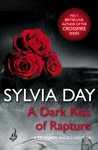
Vampire freebie. A Dark Kiss of Rapture, by Sylvia Day.

A Dark Kiss of Rapture (Renegade Angels, #0.5)A Dark Kiss of Rapture by Sylvia Day

My rating: 3 of 5 stars

A Dark Kiss of Rapture is the free beginning of Sylvia Day’s Renegade Angels series which follows angels who have been cast out of heaven and punished with vampirism for falling in love with mortals. Or like to sleep with them as is the case with protagonist Raze. Then he meets Kim, a discovery that would be less complicated were it not made in the wake of killing the mate of a rebellious vampire leader.

It’s a bit of Underworld, True Blood, and Twilight mixed together then finished off with a biblical origin not so dissimilar to Dracula 2000.
I find it difficult to rate highly because it is for the most part the same vampiric ground being trod; any one who has read Kiss of Midnight by Lara Adrian will find the style and tone similar. Though this seems to be something Day is aware of and flags up in a later scene. Being intentional I can’t fault her, it’s one thing to take writing a cheesey vampire fic seriously, it’s entirely forgiveable to just be having fun with the genre which is what I think Day is doing.

Previous to reading anything by Day I had heard her likened to E.L. James. I find that hard to believe since Day knows how to write a plot with depth, and her vocabulary is multi-syllabic – even if at times she does wander into gothic, slightly melodramatic Poe-esque language rather typical of the genre.
Oh, and she can write a decent sex scene without being afraid of the word ‘clitoris’.

Alright, it’s not the second coming of Polydore but I never expected it to be. It’s a good little vampire fic which I think can be read standalone as well as as a series. Plus there is nothing to lose since it’s free on Amazon, even if you are only reading it for the sex scenes.

View all my reviews

Familiar stories but drunker. Zeus Grants Stupid Wishes, by Cory O’Brien.

Zeus Grants Stupid Wishes: A No-Bullshit Guide to World Mythology

Zeus Grants Stupid Wishes: A No-Bullshit Guide to World Mythology by Cory O’Brien

My rating: 4 of 5 stars

Ever wondered what your favourite myths would sound like if they were told my a drunk frat boy, or someone from Tumblr who’d had too much coffee and slept too little? You found it.
From the familiar faces of Greek, Norse, and Egyptian mythology, across Japanese, Chinese, and into Mayan and Native American (with some modern American for good measure…) O’Brien de-mythologises mythology. Instead they’re written as they’ve probably been told in mead halls and over fires for centuries – lewd, crude, and who gives a fuck they’re Gods.

I was surprised, and relieved, it wasn’t just the usual mythology suspects (Greek, Norse, Egyptian…) although I found the book less coherent with the lesser known myths/cultures. It could be possible that having a basic knowledge of the ‘big 3’ made it easier to follow the retellings, or as the source material for some of the Mesoamerican myths are missing (in history, not this book) so the author has to jump sections.

If read in long sittings the humour can get repetitive but you could reflect and say this is because the myths themselves – regardless of location, culture, or language – are repetitive and the author can only make so many jokes about marrying your Goddess sister, and getting drunk/high with animals before destroying the world in a flood. In a way even this repetitiveness has a place in the book because, as is alluded to in the conclusion, it highlights that either everyone is calling the same God(s) and events different names or that human psychology rationalises the unexplained in a universal and predictable manner.
Either way we all need to shut up, drink more mead, and tell stupid stories about Loki banging a horse.

Content warning: frequent swearing, frequent references to sex and drugs. (Not sure what else you were expecting from the title…)

Zeus Grants Stupid Wishes: A No-Bullshit Guide to World Mythology by Cory O’Brien, Paperback £9.99, also available in ebook formats.

View all my reviews

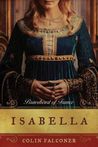
Isabella: Braveheart of France, by Colin Falconer.

Isabella: Braveheart of FranceIsabella: Braveheart of France by Colin Falconer

My rating: 4 of 5 stars

Starting with her marriage to Edward II of England at the age of twelve, ‘Isabella: Braveheart of France’ follows the life of Isabella Queen of England, 1295-1358, (best known for her moniker of the She-Wolf of France) up until the death of her husband. The young princess hopes that the marriage will provide her with a gallant, knight for a husband that will love her unwaveringly, instead she is thrust into a thick political landscape which relies on her as though she were queen in her own right. Intrigue, infidelity, war, rebellion, and jealousy, all in the day’s work of being Queen.

I really enjoyed reading this. The writing is simple, in third person and the present tense, and the chapters are short making this a very easy read – I finished it in two days. The action closely follows Isabella’s perspective; although it may be argued that this is one sided (I’m not closed to suggestion that Falconer may have benefited from multiple perspectives similar to Conn Iggulden if only for the sake of dramatic irony) the focus makes Isabella accessible to anyone who does not know much about her. It gives a strong account of her thoughts and feelings, and as a historical female protagonist she is written as a woman of her time who understands what is expected -unfairly or not- of her gender both within medieval society, and as a Queen; all thankfully without modern hindsights of equality that some historical fiction writers fall in to. It was a refreshing change for such a human approach to her when Isabella is frequently written either as a weak and weary wronged wife, or a notorious bitch who is ferociously ambitious. Likewise Edward II is given the same treatment; he’s not his typical role of either arrogant and abusive husband or a foppish homosexual, though you will groan with frustration at his inability to ‘king up’ it is impossible not to sympathise with his struggles, both of existing outside of the medieval sexual norm and for being an individual not designed to be a king but thrust into the role regardless.

My only quibble is that the book would have benefited from a little extra editing. Though I did not notice any obvious typos, I was aware that the author was repetitive with their vocabulary. For example, roughly halfway through a character is described as ‘obsequious, a few pages later the same is said again, and again a few pages later, as though the author had just learnt the word and felt the need to use the new knowledge. Also sometimes it was difficult to tell who was speaking in a long block of dialogue, especially if there was more than two characters, as Falconer doesn’t use way-pointing ‘he said’ or ‘she said’.

I’ll admit I initially worried this would be a cheesy take on history (especially after the whole ‘Braveheart’ thing) but it’s not and I really enjoyed reading this. If you prefer your historical novels to not be trite and melodramatic, or violent gorenography, then I would definitely recommend this book. However, if you are looking for a Guinevere and Lancelot style story about Isabella and Mortimer then this is probably not for you.

Content warnings: Infrequent swearing, infrequent non-explicit sex scenes.

Isabella: Braveheart of France by Colin Falconer, Paperback £8.99, also available in audio and ebook formats.

Disclaimer: I was provided with a free Kindle edition by NetGalley in exchange for an honest review.

View all my reviews