Happy New Year, good luck everyone.

Tomorrow, and tomorrow, and tomorrow,
Creeps in this petty pace from day to day,
To the last syllable of recorded time

Good lord, it’s January.

I swear it was March only last week, and this weekend just gone we were in the middle of a heatwave that had my sister and I sat on the patio up to our knees in gallon buckets of cold water.

Everyone’s probably tired of hearing the soundbite about “may you live in interesting times” being a Greek (Roman?) curse, but I’m going to repeat it anyway. Without a doubt we are living through a year, or at the very least pandemic, that will have it’s own chapter in history books about the early twenty-first century. That said, for me there’s a disconnect between knowing I’m stuck in history and actually feeling like it. So far, touch wood, I’ve been lucky and the virus hasn’t touched my life (and, yes, I know, tempting fate by putting it into writing). My sister has received the first half of the vaccine, and I’ve spent most of the year furloughed, kept at home hopefully out of reach of infection. It’s a bit like how I felt about cancer before 2016; it exists but it doesn’t involve me, until it did.

It’s been a strange year hasn’t it? Some reading this have had life return to something resembling reality, others are ducking and dodging the combined irresponsibility of their governments and gleefully ignorant countrymen. For all the time I had to spend at home working on my own projects I didn’t get much done, and it’s not like I couldn’t bear to do anything I just didn’t have any gumption. Setting deadlines for myself didn’t work either, as I was (am) entirely aware that when there’s nothing to do time has no meaning except which meal you’re preparing. So that’s where I’ve been; I’ve not been ill, I’ve not given up on this blog, I’ve just been ‘here’. Actually I haven’t done a whole lot of anything… except play a lot of Dragon Age: Origins over the November lockdown.

I won’t say good riddance to 2020, and I won’t say anything hopeful about 2021 either – unlike apparently everyone on social media. Since 2016 we’ve looked ahead on December 31st with a “well it can’t get worse!”. And then it did, steadily every year that followed. Just when you thought fate/chance/luck/nature had no moves left to play, something else was thrown at us. For all we know we could be jinxing it and whatever Trickster God is in charge of the universe clearly doesn’t like being challenged. I swear to God it’s like being the neighbours of the idiots who dug up a Jumanji board. Which is why I’ll say good luck. Whether it’s a well needed blessing to survive whatever disaster, or political machinations trample over us, or gentle encouragement to embrace whatever freedom we find coming out the other side.

So no resolutions, no plans, no “202x is going to be my year!”, just a very neutral recognition that 2021 is going to be a year. It is after 2020, it will lead to 2022, and when it’s over we’ll all say “happy new year” again.

Lust for Life, by Irving Stone.

Lust for LifeLust for Life by Irving Stone
My rating: 3 of 5 stars

Lust for Life is a fictional biography of the post-Impressionist painter Vincent van Gogh. Written as a historical novel Stone presents readers with a good and general overview of Vincent’s life that does not restrict itself to the later years and Vincent’s famous reputation of an ear mangling madman. The book was written using Vincent’s own letters for reference and any one who has read them will recognise certain passages or letters turned to dialogue as they read. However, the book merely skims the surface of who Vincent was and doesn’t really ‘pick up’ until Vincent reaches Paris half way through the book. This I found curious since we know relatively little about Vincent’s stay in Paris – during the period he lived with his brother, Theo, causing there not to be copious letters to document the time. As a result Vincent’s time in Arles (his most creative period) and final battles with his mental health are crammed into the last one-hundred pages. The book is also frustratingly simplistic at times, almost forgetting that it’s fictional and has a licence to emote, leaving the reader a cautious and slightly anaemic description of life that was as explicit and as vivid as the colours Vincent painted with.

As a piece of historical fiction I do accept that certain liberties were taken with Vincent’s life – an easy example is early in the book where a letter conversation has been retold as Theo visiting Vincent – but it felt like some of the historical accuracy was thrown under the figurative bus either because Stone was pandering to period typical taboos and ignorances concerning mental health and sexually transmitted diseases, or from Stone’s own (or I suppose the public’s) hero worship of Vincent. The mental health especially; having read Vincent’s Letters it is quite apparent that Vincent’s mania – whether epileptic or bipolar in origin – is present from the start and worsens as he ages, and over indulges in Absinthe. However, Stone treats it as though it was something that suddenly set on Vincent as soon as he reached Arles, with only vague allusions to obsessive tendencies played off as eccentricities before hand. The book does treat the Paris period of Vincent’s life well and it is the most enjoyable part of the book but by ignoring – or intentionally erasing – Vincent’s fitful changes in mood a key part of WHO Vincent was is lost. I do concede that this could be the fault of the 1930s and Stone not having the same access to information about Depression and mental health disorders in general. However, Stone also erases the fractious relationship between Vincent and his father, Theo’s hand in separating Vincent and Sien, and completely fails to mention the time Vincent spent in a hospital in the Hague most likely being treated for syphilis – the condition is hinted at very, very late in the book but never said out right. Whether it was Stone’s own hero worship or not wishing to besmirch the name of a well loved painter by missing Vincent’s flaws, or even trying to counteract the known reputation of Vincent as a lunatic, I felt that the book did not give a true, whole depiction of the painter as a man.

Another fault, at least from my point of view, was Stone’s depiction of the women in the book. Yes, 1930s I should know better than to expect much but for every relationship it is the woman at odds with Vincent or at fault. Having read the letters I know Sien was no angel but neither was Theo, yet when it comes to the relationship Stone writes it as entirely her fault that the relationship breaks down while Theo is completely absolved. Something similar happens later once Vincent has returned to his parents’ home; while living in Nuenen Vincent is involved with Margot Begemann, her sisters are vindicated in the destruction of the relationship (quite rightly since they were absolutely horrid) but the violent arguments Vincent had with his father are entirely missing. While I accept that such a work has to be more interested in the personal life of the central figure for the sake of drama, the constant use of women as Vincent’s antagonist just seemed cheap. Surely the antagonist of Vincent’s life, if he had one, were the gallery owners and art dealers that refused to show his work? Instead they are treated as necessary challenges for Vincent to over come, even his mental illness is given a similar treatment, while the women are consistently the only destructive influences in his life – a very odd conclusion for Stone to reach when the obvious destructive influence was the toxic quantities of absinthe Vincent was drinking!
This falls back onto my previous comment about hero worship, in making the women ‘bad’ the criticism could be shifted off of Vincent and he continues to fit the ‘struggling artist’ character mould rather than a genuine depiction of the flawed and tormented, albeit wonderful, man that he was.

Overall it is enjoyable and should be read for what it is – a fictional account of a man who the writers wishes he could have met. I think, if you are interested in Vincent van Gogh, it is a book you should read before reading Van Gogh: The Life or any edition of The Letters of Vincent van Gogh, as knowing more about the man than what the book gives only leads to exasperation when you notice something missing.

Note: Even though this edition was published in 1990 the text is littered with phrases in French from Millet (and for the sake of affectation) with no translation footnotes. I read the book with google translate open!

View all my reviews

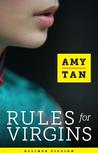
Rules for VirginsRules for Virgins by Amy Tan
My rating: 2 of 5 stars

Full disclosure: Not really a book, more of a vignette extracted and adapted from Amy Tan’s book “The Valley of Amazement”.

It’s written in the style of a long monologue, or lecture, from an experienced courtesan while mentoring a virgin courtesan. Just as Machiavelli made a list of rules for a Medici prince, this work lays down the law of being a Shanghai courtesan and how a virgin can make the most of her naivety; which songs to learn and why, how to speak inside the jewellery shop with a patron, how to deal with clients who expect more than they paid for, ways to maintain a good reputation, etc.

If you’ve read “Memoirs of a Geisha” this will seem incredibly familiar. It reads like a missing chapter from during Sayuri’s education and, barring the difference in setting, if you imagine it it’s not hard to hear Mameha giving the lesson.

It’s a light read, both in tone and length, and it’s interesting. Not only to those with an interest, fictionally or otherwise, in this era of China’s past or of this section of culture; but also into the assumed value of a woman in a male dominated subculture and, to greater extent, society. Plus it’s free on Kindle which is always a advantage.

View all my reviews

The HobbitThe Hobbit by J.R.R. Tolkien
My rating: 5 of 5 stars

‘The Hobbit’ is an adventure story following the journey of Bilbo Baggins, a hobbit (a species of small folk found in Middle Earth), after having been hired by a band of dwarves to travel to their former home in the mountains to reclaim it from the dragon, Smaug.

The book charming and typically British… Or typically so of the period in which the book was written. However, at times it is a little long winded. Reputedly Tolkien would take forever to walk around a garden because he’d pause to look at every tree and flower… That rather explains ‘The Hobbit’. Not that it’s boring, merely that Tolkien does capture the often ignored longness of a journey actually requires but thankfully it is broken up with a goblin chase, a cursed forest, the prisons of an elven king, a dragon, and a battle that will break your heart.

That being the case. Tolkien is fantastic at describing settings and characters – and I would hope so since he created the entire world of Middle Earth from scratch – his only let down are the action scenes which are frequently over before they can gather momentum, a clear example of this would be Smaug [spoiler] attacking Lake Town.

You’ll love Bilbo as a hero, he’s not the infallible ‘superman’ type hero typical of action genre – fantasy or otherwise. Bilbo is middle-aged when the dwarves arrive to hire him, he likes his creature comforts, and where it not for being a hobbit you could describe his as ‘the every man’. He goes through the book with the wits of someone who would most definitely survive a horror story – not because he can miraculously defeated the bad guy, but because he’s the sort to listen to the millions of ‘don’t go in there’ screams. Plus he’s occasionally a snarky little shi- hobbit, which I greatly appreciated in the current climate of congenial Mary/Marty-Sues.

View all my reviews